
Note
Go to the end to download the full example code.
Loading and Plotting MHD Data#
This example introduces the two steps needed to go from a PSI data file to a rendered scene:
Fetching a dataset —
psi_data.fetch_mas_data()downloads (or retrieves from cache) a version-pinned HDF5 file from the PSI asset server and returns its local path.Reading the data —
read_hdf_by_index()loads the array values and the three coordinate grids \((r, \theta, \phi)\) from the file. PassingNonefor a dimension selects its full extent; passing an integer index fixes that dimension to a single grid point.
The dataset used here is the radial magnetic field \(B_r\) from an HMI-driven MAS standard run for Carrington Rotation 2309 (CR 2309), covering the coronal domain \(r \in [1,\,30]\,R_\odot\).
from __future__ import annotations

from psi_data import fetch_mas_data
from psi_io import read_hdf_by_index

from pyvisual import Plot3d
Fetching a Dataset#
psi_data.fetch_mas_data() accepts a domain identifier
('cor' for the coronal domain, 'hel' for heliospheric) and a
variable name. It returns a namedtuple() whose fields
are named "{domain}_{variable}". The first call downloads the file to
the local cache; subsequent calls return the cached copy immediately without
hitting the network.
datasets = fetch_mas_data(domains="cor", variables="br")
br_file = datasets.cor_br
Reading a 2-D Radial Slice#
read_hdf_by_index() reads the HDF5 file and returns
(data, r, t, p) — the scalar array followed by the three coordinate
vectors. Index arguments control which portion of the grid is loaded:
None— load the full extent of that dimension.An integer
i— fix that dimension to thei-th grid point (1-based), collapsing it to a length-1 array.
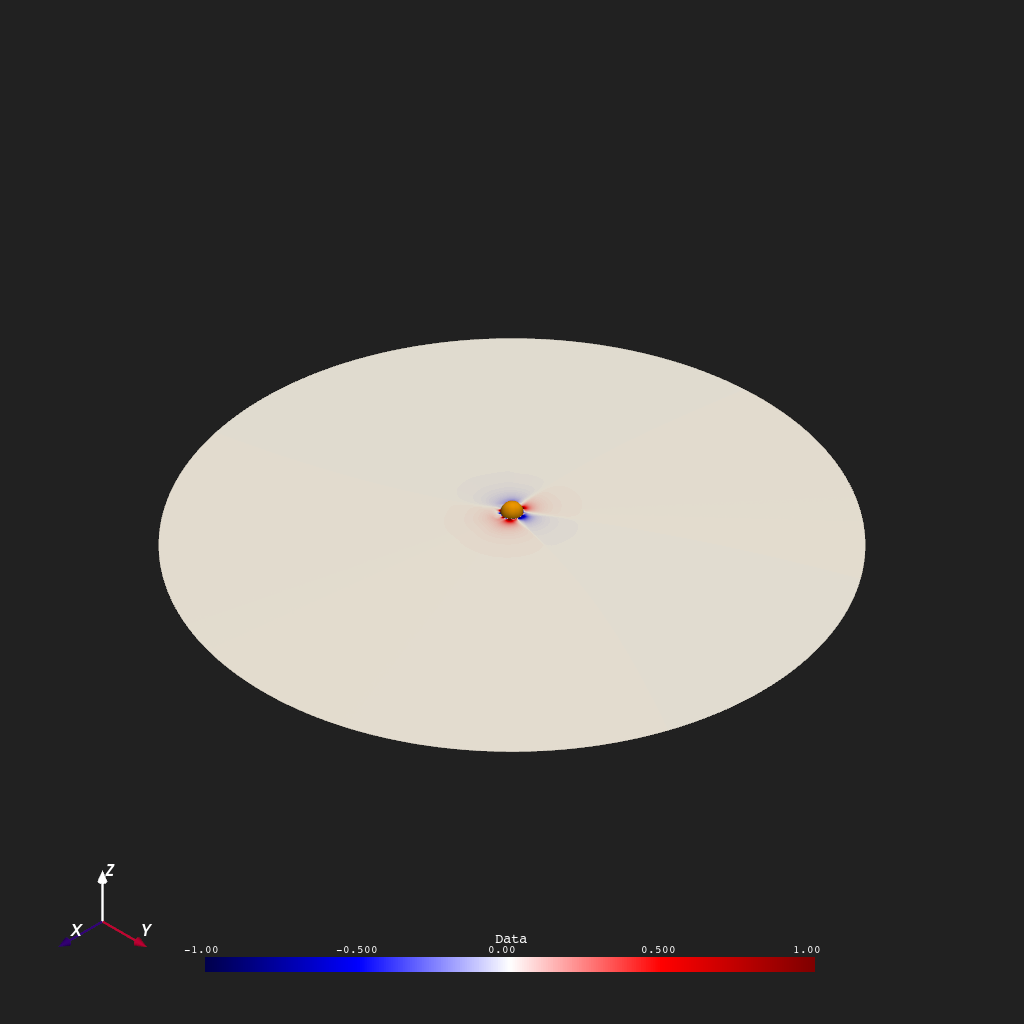
Here the colatitude is fixed at index 71 (the equatorial plane, \(\theta_{71} \approx \pi/2\)), while \(r\) and \(\phi\) span their full extents. The result is a 2-D surface in the equatorial plane colored by \(B_r\).
Scaling by \(r^2\)#
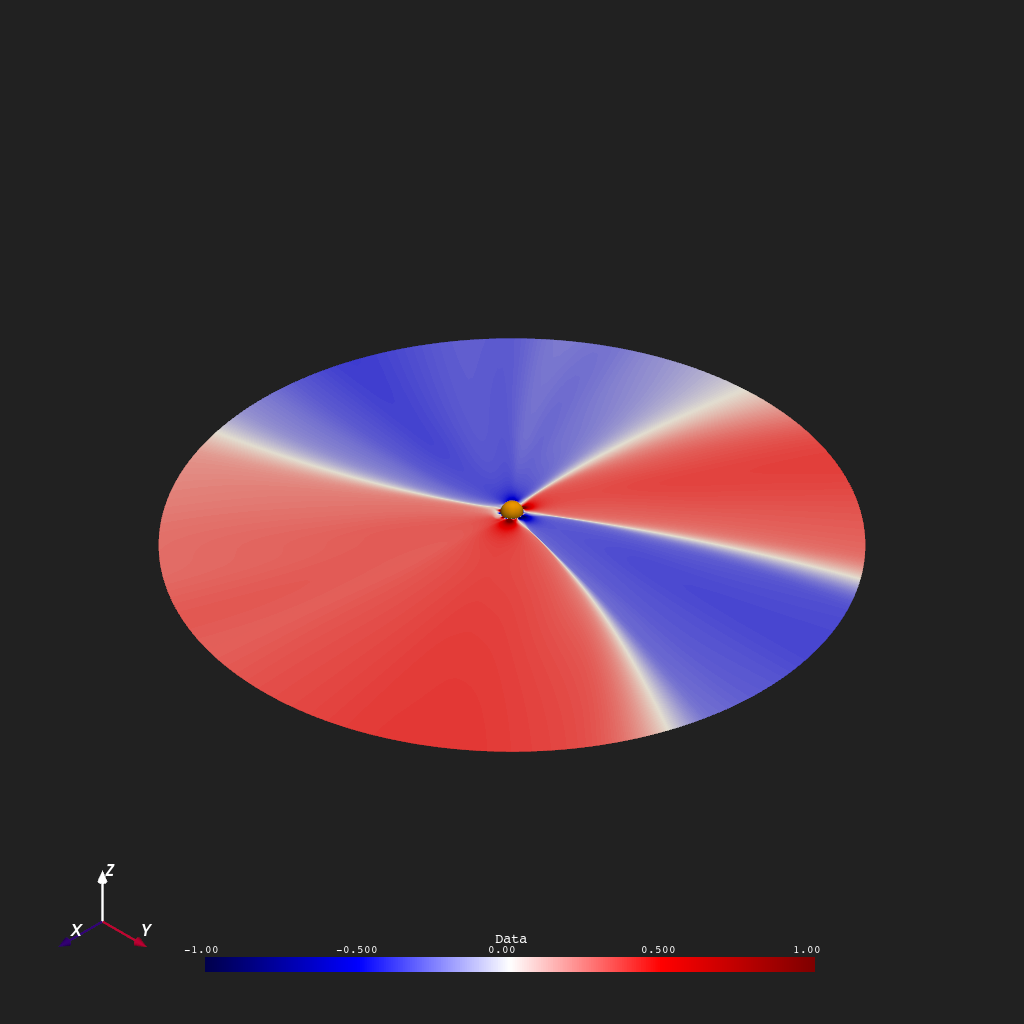
The radial magnetic field falls off geometrically as \(1/r^2\) with
distance. Multiplying by \(r^2\) removes this trend and reveals the
longitudinal structure of open-field regions at all radii — a common
diagnostic in solar wind modeling. Because r is a plain NumPy array,
the scaling is a single element-wise operation before passing to the plotter.
plotter = Plot3d()
plotter.show_axes()
plotter.add_sun()
plotter.add_2d_slice(r, t, p, data * r**2, cmap="seismic", clim=(-1, 1), show_scalar_bar=True)
plotter.show()
Total running time of the script: (0 minutes 1.497 seconds)