
Note
Go to the end to download the full example code.
Shells and Discs#
This example demonstrates add_shell()
and add_disc() — convenience methods
for adding spherical shells and planar discs to the scene as reference
geometry.
Source-Surface Shell#
add_shell() adds a spherical shell
defined by inner and outer radii, centered at an arbitrary spherical position.
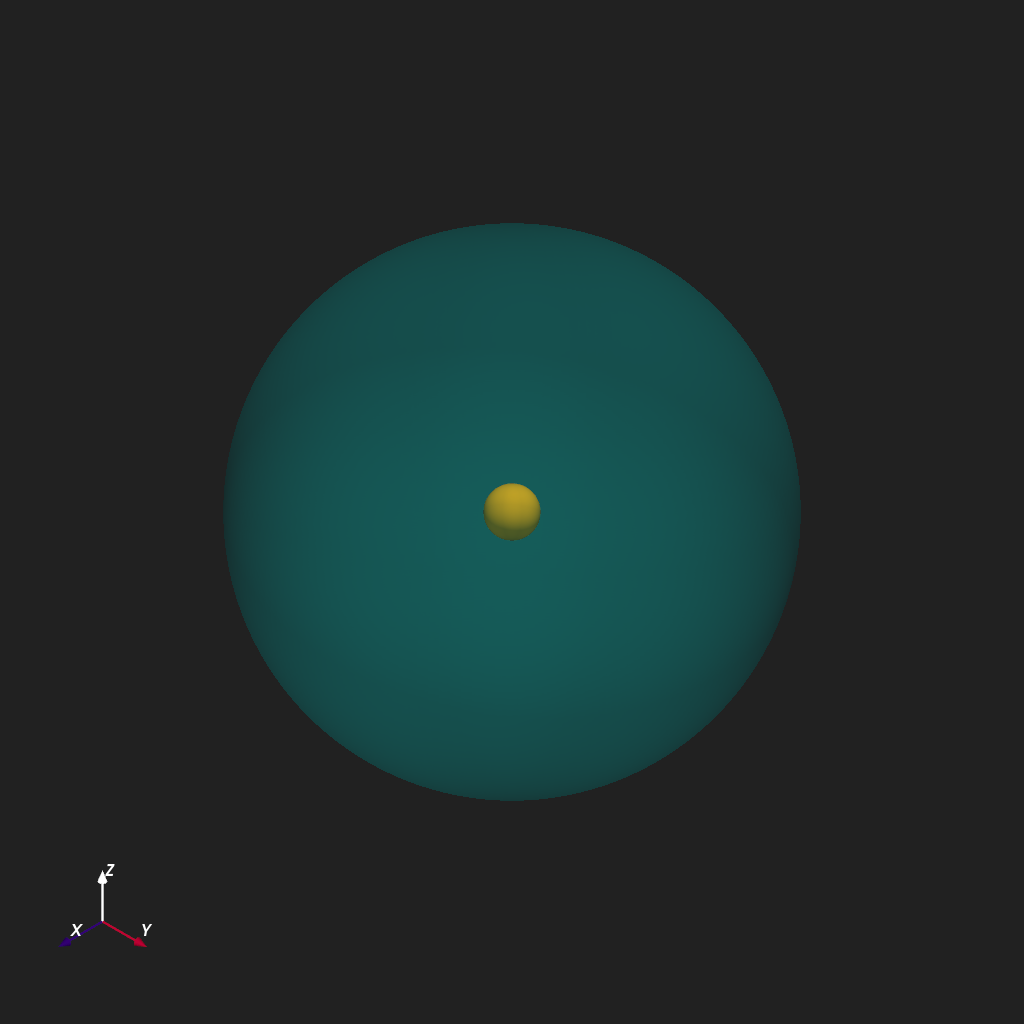
Here, a translucent shell at \(r = 10\,R_\odot\) represents the
source surface — the heliospheric boundary beyond which coronal field lines
are considered open.
plotter = Plot3d()
plotter.show_axes()
plotter.add_sun()
plotter.add_shell(outer_radius=10, opacity=0.2, color="cyan")
plotter.show()
Positional Markers#
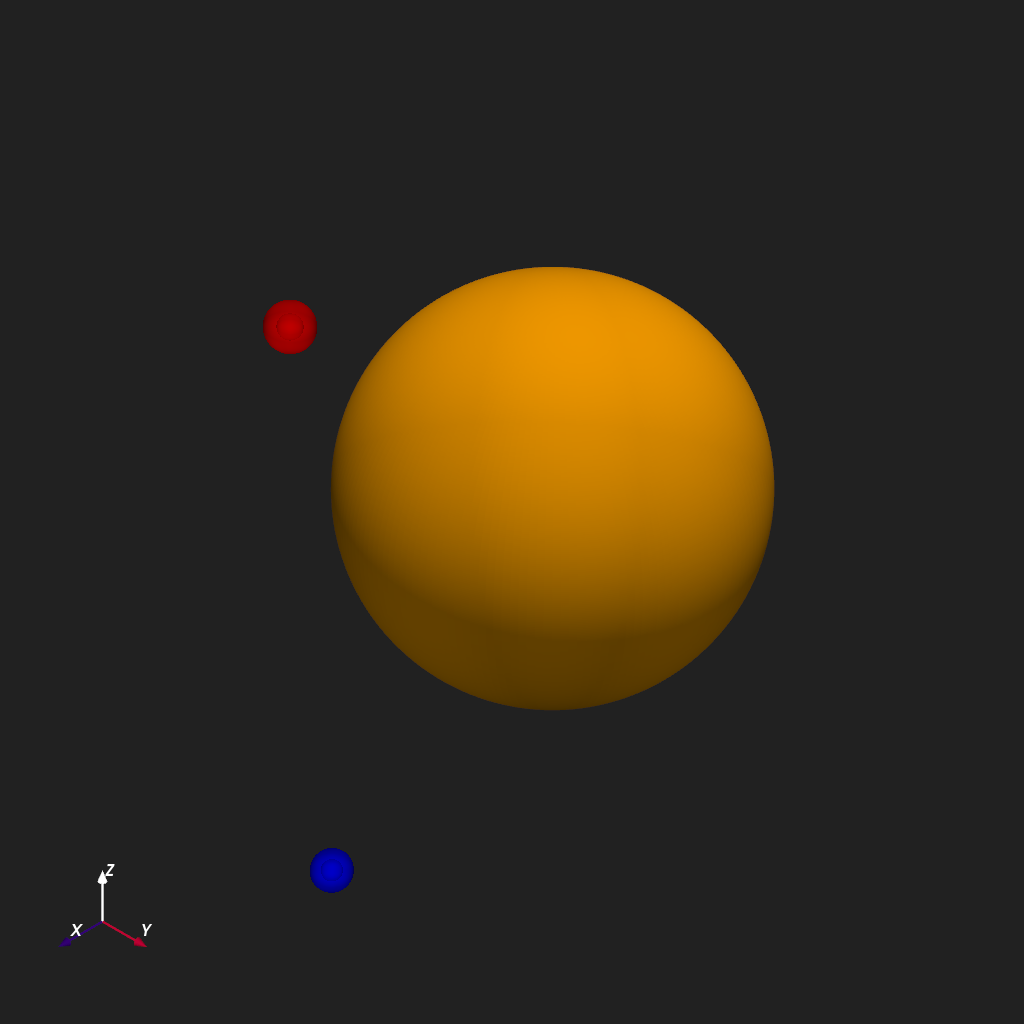
Shells can also be placed at off-center positions to mark specific locations in the corona. The two small shells below are placed at symmetric latitudes in the northern and southern hemispheres at \(r = 2\,R_\odot\).
plotter = Plot3d()
plotter.show_axes()
plotter.add_sun()
plotter.add_shell(2, pi / 4, 0, inner_radius=0.05, outer_radius=0.1, color="red", opacity=0.8)
plotter.add_shell(2, 3 * pi / 4, 0, inner_radius=0.05, outer_radius=0.1, color="blue", opacity=0.8)
plotter.show()
Local Basis Discs#
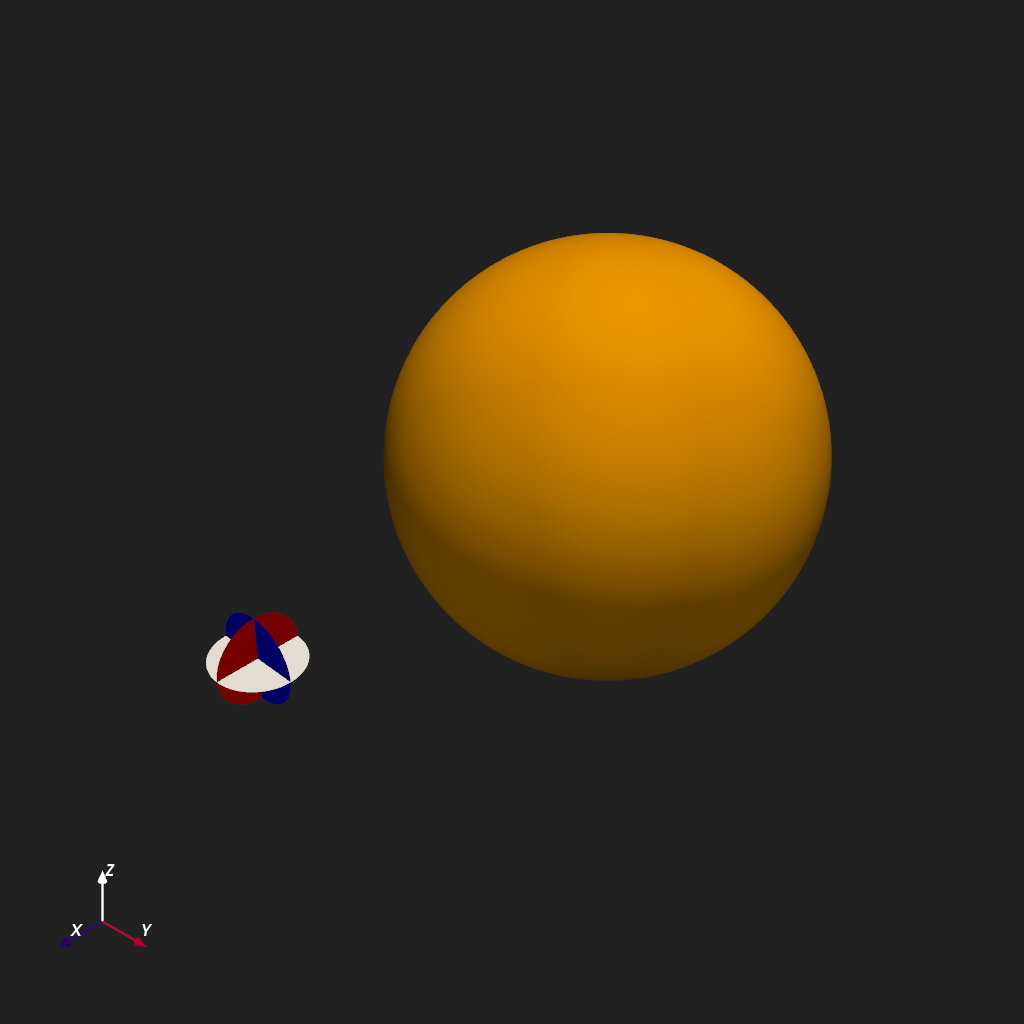
add_disc() creates a planar disc
whose normal is specified in the local spherical basis
\((\hat{r}, \hat{\theta}, \hat{\phi})\) at the disc center. The three
discs below illustrate each basis direction at
\((r=2\,R_\odot,\,\theta=\pi/2,\,\phi=0)\):
radial \(\hat{r}\) (blue), colatitudinal \(\hat{\theta}\) (white),
and longitudinal \(\hat{\phi}\) (red).
disc_kwargs = {"r": 2, "t": pi / 2, "p": 0, "outer_radius": 0.2}

plotter = Plot3d()
plotter.show_axes()
plotter.add_sun()
plotter.add_disc(**disc_kwargs, normal=(1, 0, 0), color="blue")
plotter.add_disc(**disc_kwargs, normal=(0, 1, 0), color="white")
plotter.add_disc(**disc_kwargs, normal=(0, 0, 1), color="red")
plotter.show()
Total running time of the script: (0 minutes 3.366 seconds)