
Note
Go to the end to download the full example code.
Constructing a CartesianMesh#
This example demonstrates how to build a
CartesianMesh from NumPy arrays and how to
convert a SphericalMesh to Cartesian
coordinates for direct PyVista rendering.
CartesianMesh wraps
pyvista.StructuredGrid with a Cartesian-frame tag. Because the
underlying grid type is a structured grid (not a rectilinear grid), the three
coordinate arrays must be 3-D meshgrids of identical shape, not independent
1-D axis vectors.
from __future__ import annotations

import numpy as np

from pyvisual import Plot3d
from pyvisual.core.mesh3d import CartesianMesh, SphericalMesh
Building from 3-D Meshgrid Arrays#
Create a CartesianMesh from a regular
Cartesian grid. Each coordinate array must have the same 3-D shape.
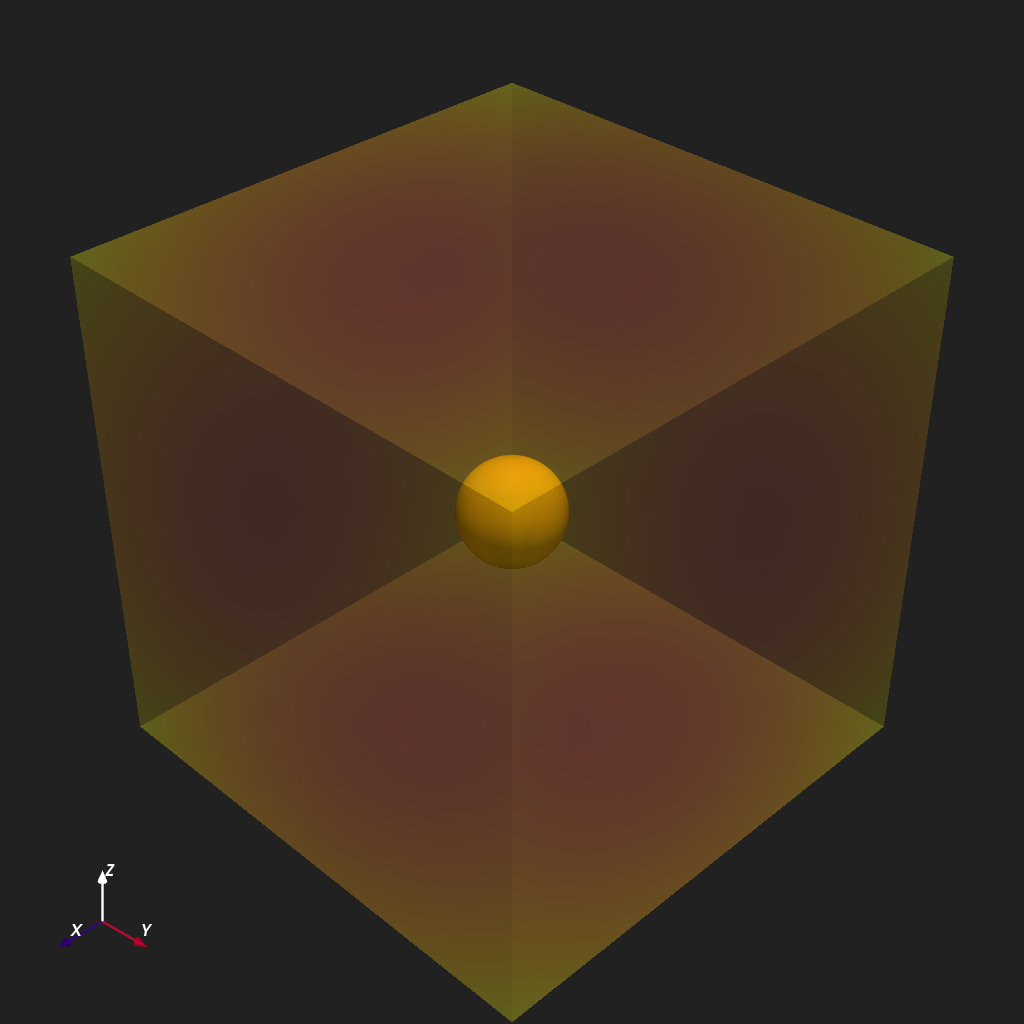
Here we build a sphere of radial-distance data, which is everywhere equal
to \(\sqrt{x^2 + y^2 + z^2}\).
x = np.linspace(-5, 5, 15)
y = np.linspace(-5, 5, 15)
z = np.linspace(-5, 5, 15)
X, Y, Z = np.meshgrid(x, y, z, indexing="ij")
dist = np.sqrt(X**2 + Y**2 + Z**2)

mesh = CartesianMesh(X, Y, Z, data=dist, dataid="r")
print(f"dimensions : {mesh.dimensions}")        # noqa: T201
print(f"data range : [{mesh.data.min():.2f}, {mesh.data.max():.2f}]")       # noqa: T201

plotter = Plot3d()
plotter.show_axes()
plotter.add_sun()
plotter.add_mesh(mesh, cmap="plasma", opacity=0.3, show_scalar_bar=False)
plotter.show()
dimensions : (15, 15, 15)
data range : [0.00, 8.66]
Converting a SphericalMesh to Cartesian#
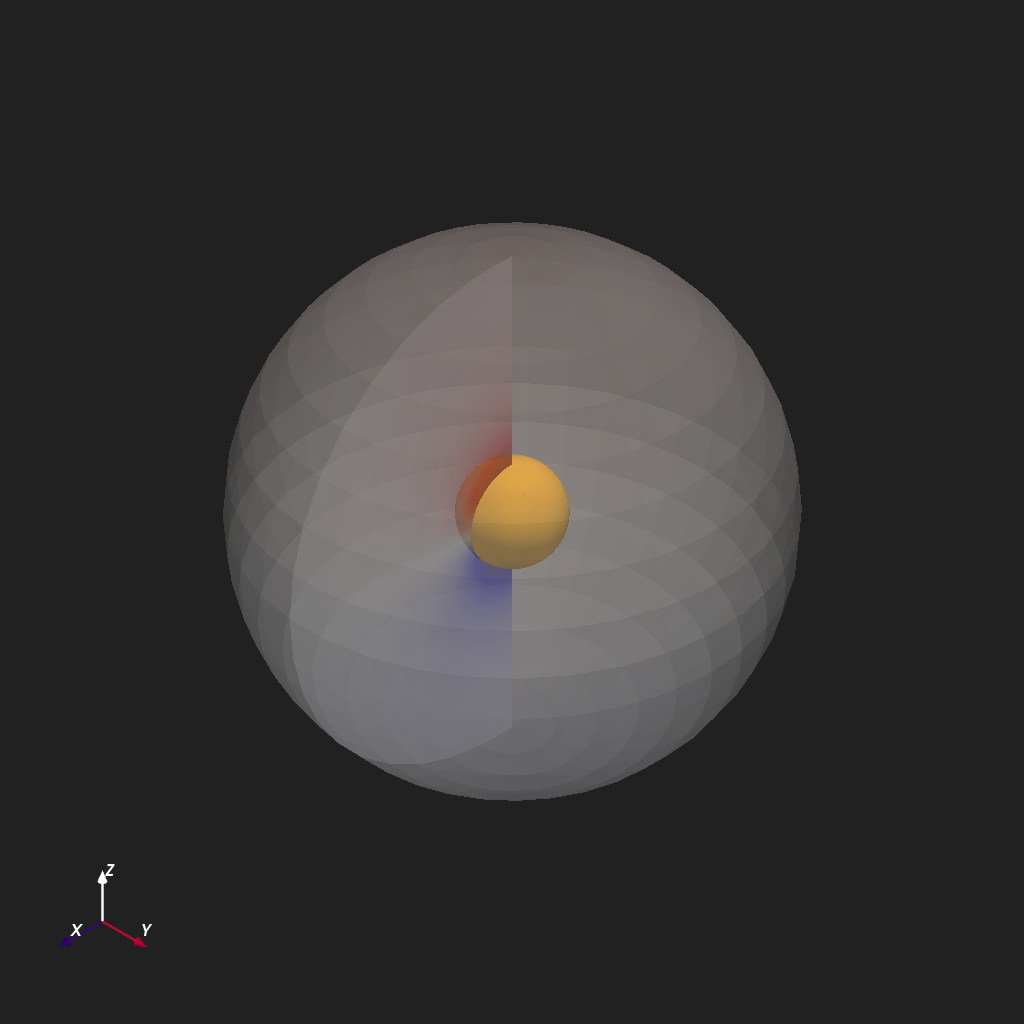
spherical_to_cartesian()
casts a SphericalMesh to a
pyvista.StructuredGrid with Cartesian point coordinates. The
resulting dataset can be wrapped in a CartesianMesh
for continued processing with the filter API, or added directly to the
plotter.
This conversion is useful when you want to apply Cartesian-space filters
(such as PyVista’s clip, threshold, or extract_surface) to data
that was originally defined on a spherical grid.
r = np.linspace(1, 5, 10)
t = np.linspace(0, np.pi, 20)
p = np.linspace(0, 2 * np.pi, 40)
R, T, P = np.meshgrid(r, t, p, indexing="ij")
Br = np.cos(T) / R**2

sph_mesh = SphericalMesh(r, t, p, data=Br, dataid="Br")
cart_struct = sph_mesh.spherical_to_cartesian()
cart_mesh = CartesianMesh(cart_struct)

print(f"SphericalMesh frame : {sph_mesh.user_dict['MESH_FRAME']}")      # noqa: T201
print(f"CartesianMesh frame : {cart_mesh.user_dict['MESH_FRAME']}")     # noqa: T201

plotter = Plot3d()
plotter.show_axes()
plotter.add_sun()
plotter.add_mesh(cart_mesh, cmap="seismic", opacity=0.4, show_scalar_bar=False)
plotter.show()
SphericalMesh frame : spherical
CartesianMesh frame : cartesian
Total running time of the script: (0 minutes 0.895 seconds)