
Note
Go to the end to download the full example code.
Polarity-Inversion-Line Seeded Fieldlines#
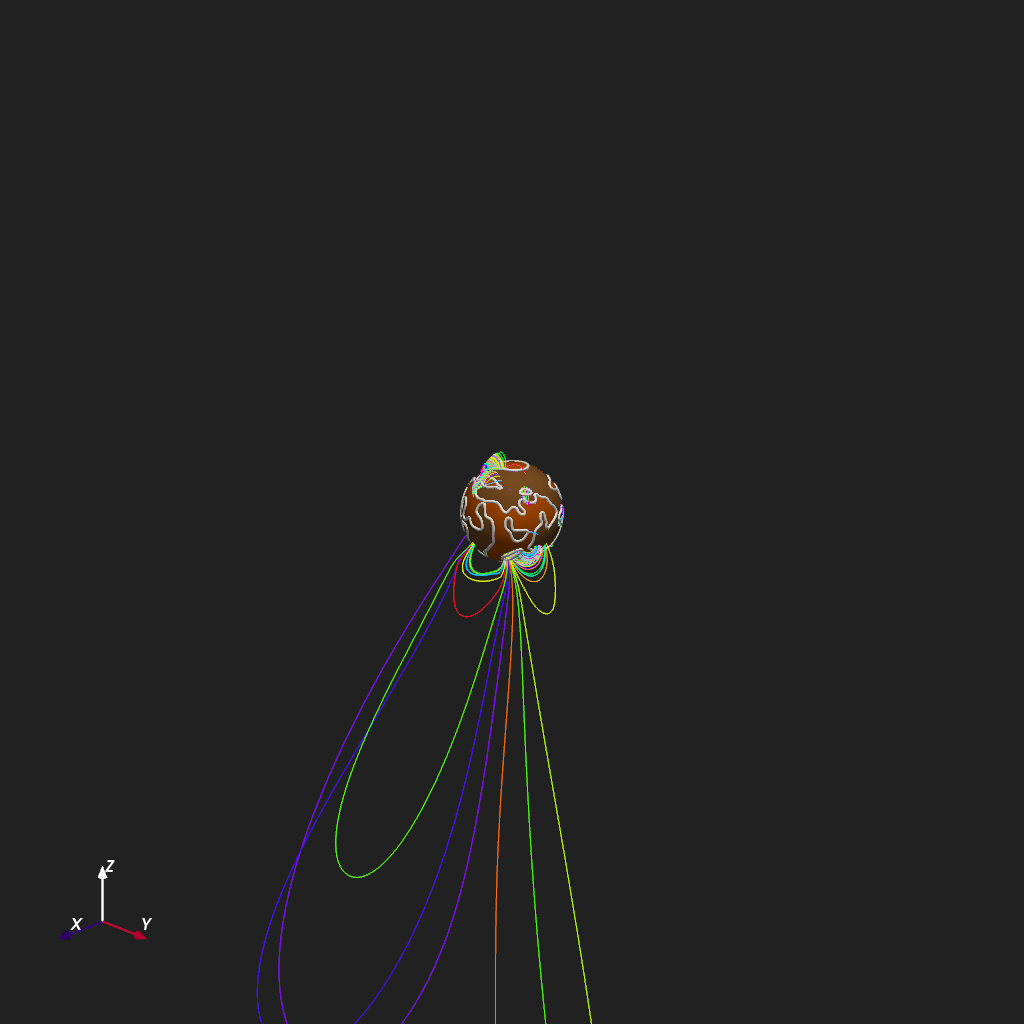
This example traces magnetic fieldlines seeded from the polarity inversion line (PIL) — the curve on the solar surface where the radial magnetic field \(B_r\) changes sign. The PIL marks the boundary between open positive and negative flux and is a natural seed surface for displaying the global topology of the coronal field. It can be used to locate the apex of coronal arcades and/or highlight bald-patch topologies.
The workflow exploits a key property of
SphericalMesh: because it wraps a
pyvista.RectilinearGrid whose internal axes store
\((r, \theta, \phi)\) directly, PyVista’s
pyvista.DataSetFilters.contour() returns a
pyvista.PolyData whose points array is already in
\((r, \theta, \phi)\) coordinates. This means the contour points can
be passed straight to
run_fwdbwd_tracing() as launch_points without
any intermediate coordinate conversion.
See also Plotting Magnetic Fieldlines for a general introduction to fieldline rendering, and Combining Slices, Contours, and Fieldlines for a broader scene that layers slices, contours, and fieldlines.
from __future__ import annotations

import numpy as np
from mapflpy.scripts import run_fwdbwd_tracing
from psi_data import fetch_mas_data

from pyvisual import Plot3d
from pyvisual.core.mesh3d import SphericalMesh
Load Data and Extract the Polarity Inversion Line#
Build a full SphericalMesh from the coronal
\(B_r\) HDF file. Index mesh[5, ...] selects a 2-D spherical shell
at radial index 5 — a thin pyvista.RectilinearGrid that spans the
full \((\\theta, \\phi)\) domain at a fixed \(r\). The ellipsis
(...) expands to fill the remaining two axes.
pyvista.DataSetFilters.contour() with isosurfaces=[0] then finds
the iso-curve where \(B_r = 0\) on that shell. The result is the
polarity inversion line as a pyvista.PolyData of line segments
whose points array holds \((r, \\theta, \\phi)\) coordinates —
because the internal axes of SphericalMesh
are the spherical coordinates, not Cartesian positions.
mag_field = fetch_mas_data(domains="cor", variables=["br", "bt", "bp"])

mesh = SphericalMesh(mag_field.cor_br)
neutraline = mesh[5, ...].contour(isosurfaces=[0])
Trace Fieldlines from the PIL#
run_fwdbwd_tracing() integrates the magnetic field
in both the forward and backward directions from each seed point, so that
every fieldline has footpoints on both the inner
(\(r = 1\,R_{\\odot}\)) and outer (\(r = 30\,R_{\\odot}\)) boundaries.
This bidirectional tracing is required for accurate polarity classification
and ensures that closed fieldlines connecting two inner-boundary footpoints
are also captured.
launch_points=neutraline.points.T passes the PIL vertices directly as
the \((3, N)\) seed array in \((r, \\theta, \\phi)\) order. No
coordinate conversion is needed because the contour inherits the
SphericalMesh coordinate convention.
numpy.moveaxis() transposes the (M, 3, N) geometry array to
\((3, M, N)\) so that unpacking with * feeds the three coordinate
components directly to add_fieldlines().
traces = run_fwdbwd_tracing(*mag_field, launch_points=neutraline.points.T, context="fork")
r, t, p = np.moveaxis(traces.geometry, 1, 0)
Render the Scene#
Three layers are combined in a single Plot3d
scene:
The radial shell
mesh[5, ...]coloured by \(B_r\), providing context for the polarity structure at the seed radius.The PIL rendered as a white tube, showing the exact seed curve.
The fieldline bundle, each line assigned a random hue via
coloring='random', illustrating the global connectivity of the coronal field anchored at the polarity boundary.
plotter = Plot3d()
plotter.show_axes()
plotter.add_sun()
plotter.add_mesh(
    mesh[5, ...], cmap="seismic", clim=(-1e-1, 1e-1), opacity=0.5, show_scalar_bar=False
)
plotter.add_mesh(neutraline, color="white", line_width=3, render_lines_as_tubes=True)
plotter.add_fieldlines(r, t, p, coloring="random", line_width=1, show_scalar_bar=False)
plotter.observer_focus = 0, 0, 0
plotter.observer_fov_view = 10
plotter.show()
/Users/rdavidson/MHDweb/pyvisual/pyvisual/utils/geometry.py:968: UserWarning: 'where' used without 'out', expect unitialized memory in output. If this is intentional, use out=None.
  np.where(mask, np.pi - np.arcsin(2 - ratio, where=mask), np.arcsin(ratio, where=~mask))
Total running time of the script: (0 minutes 16.241 seconds)